 Search Pulse
Marketing leaders who understand how AI model providers ground responses gain a significant competitive advantage. Here's how different grounding mechanisms work and what that means for your brand's visibility strategy.
Why This Matters: The Grounding Gap That Costs You Visibility
Your brand shows up differently across AI platforms not because of quality differences, but because of how model providers ground their responses with real-world information. Some model platforms rely solely on static training data, while others pull from live web searches to ground their answers. This distinction determines whether prospects discover your brand or your competitor's.
The cost of ignoring this: Brands optimizing only for search engine indexing miss a significant portion of AI-driven discovery opportunities that come from training data influence. Those understanding both channels see substantially higher mention rates in AI conversations.
The payoff: A coordinated strategy across both grounding channels increases your brand's AI visibility noticeably within weeks, according to internal SearchPulse benchmarks.
How AI Model Providers Ground Responses: Two Mechanisms
Static Pre-Trained Models with Grounding
These AI models rely primarily on their training set but use grounding techniques to provide more current information. However, even with grounding, they inherit the biases and limitations of their training data.
How they work:
- Train on massive web datasets up to a specific date
- Store brand information as embedded knowledge
- Use grounding techniques like retrieval-augmented generation (RAG) to access current information
- Still influenced by training set biases even when pulling live data
The bias problem: Even when these models use grounding, their training set creates inherent biases. If your brand wasn't well-represented in training data, the model may discount or misinterpret current information about you.
Examples: Claude, some enterprise AI deployments, specialized industry AI tools
Web-Enabled Models with Search Grounding
These models actively use online search results to ground their responses in real-time. They're like researchers who constantly cross-reference current information when answering questions.
How they work:
- Use trained knowledge as foundation
- Actively search the web for current information
- Ground responses using search engine results, news articles, and recent content
- Can reference the most recent announcements, pricing, and positioning
The opportunity: These models create an immediate visibility channel. Get indexed by the search engines they use, and you show up in AI responses.
Examples: ChatGPT with browsing, Perplexity AI, Google's AI Overviews, Claude with web access
Live Example: Frame0 vs. Excalidraw in Claude Sonnet
To see the channels in action, we ran the same queries in Claude Sonnet 4.5 with and without live web grounding. The screenshots below walk through the progression so you can spot where visibility breaks.
Without search grounding (static-only mode):
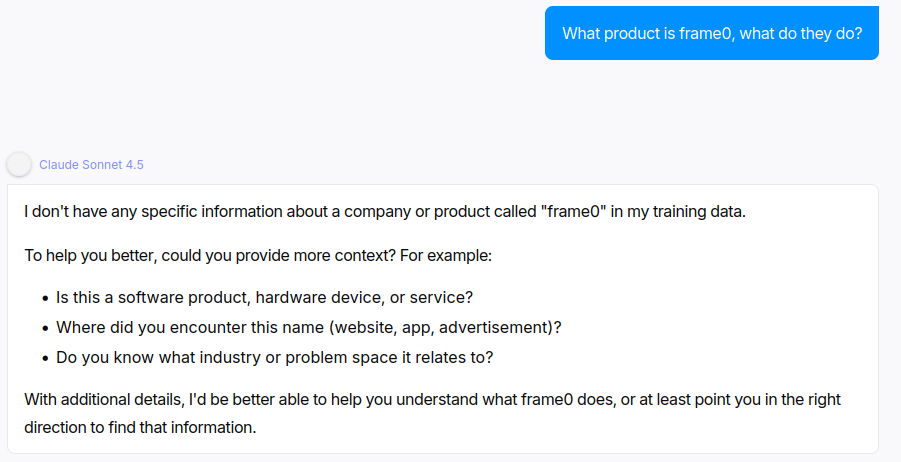
- Frame0 disappears entirely because it has little historical coverage, so the model has no embedded knowledge to draw from.
- Excalidraw still appears because its open-source community created enough durable mentions to make the training set.
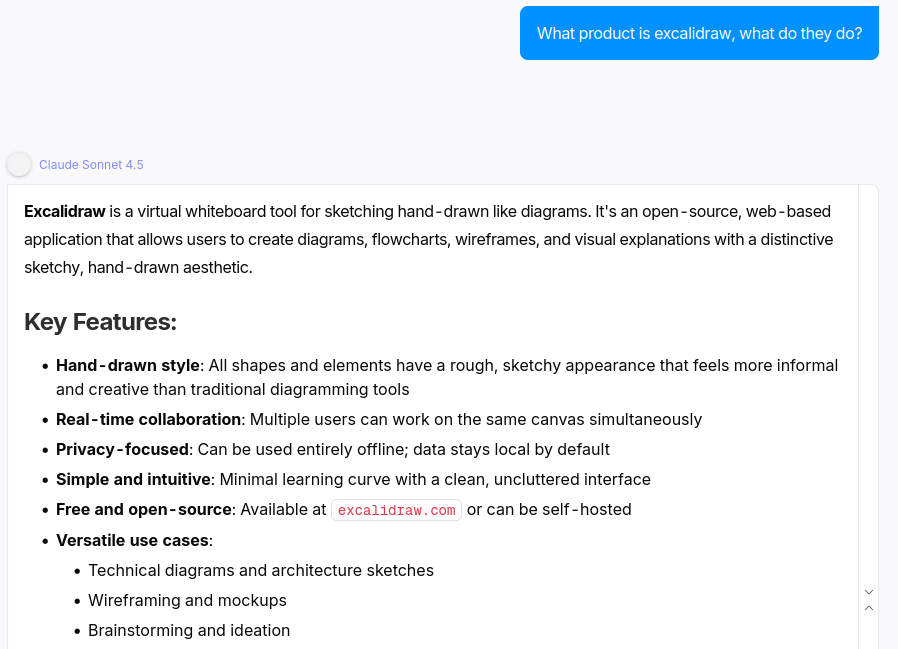
With search grounding enabled:
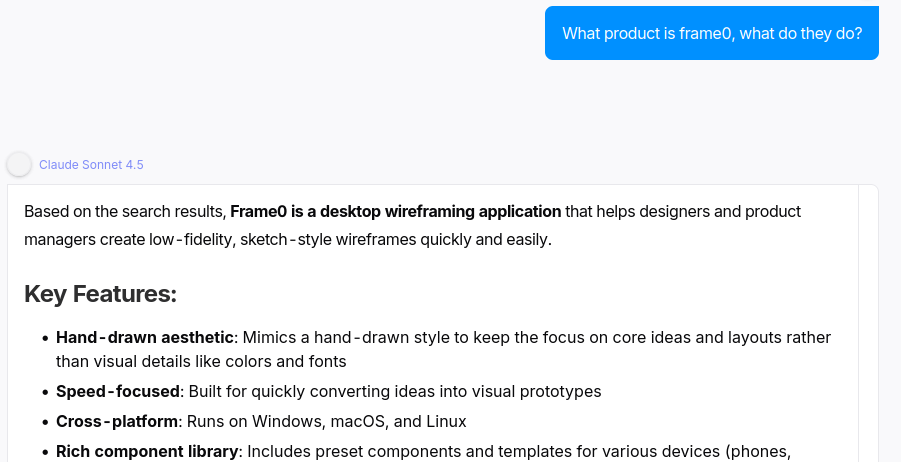
- Claude now references fresh landing pages and product updates because it can reach real-time search results.
- The model reconciles training gaps with the live data, surfacing Frame0 alongside entrenched competitors.
Why it matters: When customers ask a comparison question, the grounded model blends both channels. If only one product has search-ready content, it dominates the answer. SearchPulse tracks both channels so you know exactly when web-grounded answers start pulling in new sources or leaving gaps you need to fill.
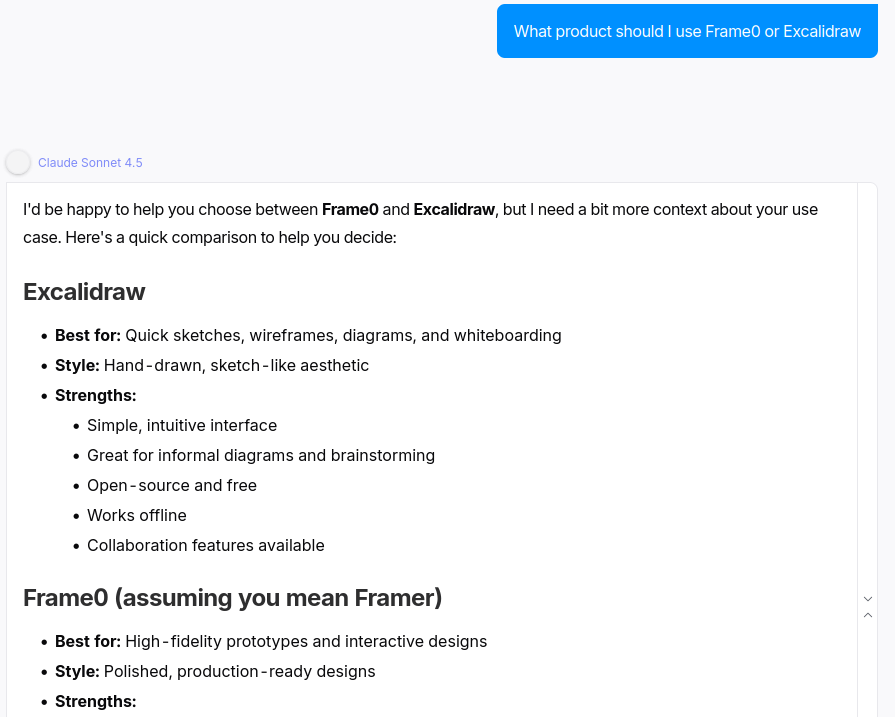
Grounding unlocks immediate visibility, but only if your brand already ranks or gets cited in the sources the model trusts.
The Two-Channel Strategy: Long-Term Training vs. Immediate Search
Brands need two distinct approaches to AI visibility: the long-term play for training data influence and the immediate play for search engine indexing.
Channel 1: Long-Term Training Set Influence
This is your foundation strategy. You're playing the long game to get positive, accurate information about your brand into model training sets.
How it works:
- Model providers periodically crawl the web to update training data
- They prioritize authoritative, well-structured content
- Multiple consistent signals across the web strengthen brand representation
- This influence compounds over multiple training cycles
Key elements to optimize:
- About pages with detailed, specific descriptions and use cases
- Product documentation that clearly differentiates from competitors
- Press coverage and media mentions from authoritative sources
- Industry reports and third-party validation
- Technical content that demonstrates expertise and thought leadership
Why this matters: Even with grounding, models inherit training data biases. If your brand is well-represented in training sets, grounding techniques work better in your favor.
Channel 2: Immediate Search Engine Indexing
This is your tactical, immediate visibility strategy. You're optimizing for the search engines that AI models use to ground their responses.
How it works:
- Web-enabled models actively search the web when answering queries
- They prioritize recent, relevant, and authoritative content
- Search engine rankings directly impact AI visibility
- This channel provides immediate results and faster feedback
Content priorities for search grounding:
- Recent blog posts answering current customer questions
- Case studies with specific, measurable outcomes
- Product updates and feature announcements
- Thought leadership on industry trends and challenges
- FAQ pages that directly address common queries
Timing advantage: Unlike the long-term training channel, search indexing provides immediate visibility. Publish today, show up in AI responses tomorrow.
Step-by-Step: Execute Your Two-Channel Strategy
1) Audit Your Current AI Visibility
Start by testing how different AI models describe your brand today. This baseline reveals which channels are working for you.
Test these queries across platforms:
- "What is [your brand]?"
- "Best [your category] tools"
- "Alternatives to [competitor]"
- "[your brand] vs [competitor]"
Document responses from:
- Static models (check for training data bias patterns)
- Web-enabled models (note if they reference recent content or search results)
2) Build Your Long-Term Training Foundation
Focus on content that will influence future training cycles. This is about building persistent brand authority.
Foundation content priorities:
- Comprehensive about page with company story, mission, and specific use cases
- Product documentation that clearly explains unique value propositions
- Authority building through guest posts, industry reports, and media mentions
- Consistent messaging across all web properties
Success metric: Multiple authoritative sources describing your brand consistently.
3) Optimize for Immediate Search Visibility
Create content that ranks well in search engines used for AI grounding.
Search-optimized content:
- Keyword-targeted blog posts answering specific customer questions
- Regular publishing schedule (at least weekly) to maintain freshness
- Technical SEO including schema markup and clear structure
- Internal linking to help search engines understand content relationships
Success metric: Ranking for relevant queries within weeks of publishing.
4) Monitor Both Channels Separately
Different channels require different monitoring approaches and success metrics.
Monitoring cadence:
- Training channel: Check monthly, focus on brand mention patterns and positioning
- Search channel: Check weekly, track content performance and ranking changes
- Competitive intelligence: Monitor how competitors appear in both channels
SearchPulse consolidates these checks into a single dashboard so you can watch responses shift in near real time and capture supporting evidence for stakeholders.
5) Balance Your Investment Based on Results
Use your monitoring data to allocate resources effectively between the two channels.
Resource allocation factors:
- Industry dynamics: Fast-moving industries may need more search channel focus
- Brand maturity: New brands often benefit from immediate search visibility
- Competitive landscape: If competitors dominate training data, prioritize search channel
- Resources available: Search channel provides faster feedback for limited budgets
Evidence & What to Watch
Internal observations from SearchPulse monitoring:
- Brands with strong training foundations see more consistent mentions across model updates, even when models use grounding
- Search-optimized content drives more mentions in web-enabled AI responses
- Companies monitoring both channels catch competitive threats weeks earlier
- Training data bias persists even with grounding, biased responses trace back to training set limitations
Common pitfalls to avoid:
- Over-optimizing for one channel while neglecting the other (most common mistake)
- Inconsistent messaging that confuses training data patterns
- Ignoring content freshness for search grounding
- Assuming grounding eliminates bias-training data still influences responses
- Focusing only on mentions without tracking positioning accuracy across channels
- Neglecting competitive monitoring in both grounding mechanisms
When to prioritize each channel:
- Training-first: Established brands in stable industries, B2B with long sales cycles, brands with existing authority
- Search-first: New brands, fast-moving markets, B2C with frequent updates, limited marketing budgets
- Balanced approach: Most brands benefit from maintaining both channels simultaneously
Strategic Takeaway
The distinction between static training data and live search grounding creates two critical visibility channels. Brands that master both channels don't just increase their AI mention rates. They build sustainable competitive intelligence advantages that compound over time.
Your two-channel strategy transforms AI visibility from reactive optimization to systematic brand intelligence. By maintaining long-term training influence while capturing immediate search opportunities, you ensure prospects discover your brand regardless of which AI platform or grounding mechanism they encounter.
Track both channels automatically? Get your complete AI visibility dashboard at SearchPulse and monitor your performance across all AI platforms.
Start monitoring your brand intelligence today: https://searchpulse.ai/auth